
Aristocrab Offspring
| |||
|---|---|---|---|

| |||
| Appears in | Pikmin 4 | ||
| Scientific name | Brachyurices esurio (hatchling) | ||
| Family | Onionshell | ||
| Areas | Serene Shores (Story Mode and Olimar's Shipwreck Tale) | ||
| Caves | Seafloor Resort, The Mud Pit | ||
| Night expeditions | None | ||
| Dandori Challenge stages | Test Tubs, Planning Pools | ||
| Dandori Battle stages | Dandori Castle | ||
| Attacks | Eat Pikmin, shoot bubbles | ||

The Aristocrab Offspring (カニンコ?, lit.: "Crab Offspring") is an enemy in Pikmin 4. It is the younger version of the Peckish Aristocrab and, like its adult form, it looks like a beige crab, with an onion-shaped body, four purple-colored legs, and two claws – the right one being much larger, and bluer, than the left one. The claws resemble real-world male fiddler crabs. The two round spots on its front look like eyes, but they are actually its gills. The real eyes are the small beads that are at the top of the stalks protruding from its head. These are the only part visible when the Aristocrab Offspring is hiding in the ground.
It shares many of the traits of the Peckish Aristocrab, like sidestepping, blowing bubbles, and using its enlarged claw to attack. One trait unique to the Aristocrab Offspring is that it can sometimes hide underground to surprise its enemies.
Stats[edit]
| Weight | Max. carriers |
Seeds | Value | Health |
|---|---|---|---|---|
| 3 | 6 | 4 |  × 3 × 3
|
450 |
Behavior[edit]
The Aristocrab Offspring acts similarly to its adult counterpart – the Peckish Aristocrab – though it's generally weaker in comparison. The Aristocrab Offspring can attack by swinging its claw around in an attempt to catch any nearby Pikmin; unlike the Peckish Aristocrab, which can grab 3 Pikmin at a time, the Aristocrab Offspring can only hold 2 Pikmin at a time. Once the Offspring has Pikmin in its claw, it will swiftly raise it above its mouth before dropping them into it, eating them promptly.
The other method it has to attack, similar to the Peckish Aristocrab, involves blowing bubbles, capable of trapping both the rookie Rescue Officer and most Pikmin members. The bubbles are ineffective against Oatchi due to his size and Purple Pikmin, Glow Pikmin, and Ice Pikmin, as they either pop upon contact or freeze. The Aristocrab Offspring blows 5 bubbles in total during 1 attack, unlike the Peckish Aristocrab, which blows many more. If the Aristocrab Offspring is able to get underneath one of the bubbles containing Pikmin, it can pluck them out with its claw and eat them.
When enough Pikmin are attacking the Aristocrab Offspring, it will buck them off before blowing some bubbles as a defense mechanism. If any Pikmin are attacking the front of the Aristocrab Offspring, they can get caught in its bubble attack.
Certain Aristocrab Offsprings can be found hidden in the ground, with only their eyes being visible. Once any Pikmin or leaders enter its territory, it swiftly jumps out before resuming normal behavior. Once its territory is left, or it loses track of any Pikmin or leaders, it will re-burrow itself.
When defeated, the Aristocrab Offspring will briefly scream before collapsing onto its torso. Its claw will instantly shatter as soon as it's run out of HP.
Locations[edit]
Strategy[edit]
|
The following article or section contains guides. |
With its low health and overall relatively low threat level, these offsprings are quite easy to deal with. You can simply use Oatchi to charge at it with a squad of Pikmin and that should finish it off pretty quickly. Unlike the Peckish Aristocrab, the offsprings cannot avoid a charge by simply standing tall and then coming back down, so charging them is quite effective at destroying them.
Notes[edit]
Dalmo's notes[edit]
Olimar's notes[edit]
“A juvenile Peckish Aristocrab. Small in size, its right pincer is only half grown. Because of this, it often hunts by hiding underground and lying in wait to ambush its prey.
Generally, crabs pass through the larval stages zoea and megalopa as they approach juvenile crabhood. Instead, the Peckish Aristocrab is born with a body shaped like an onion, absorbing its nutrition through the ground and sprouting legs as it grows. Perhaps it's a close relative of species in the Ambuloradicis class.”Louie's notes[edit]
Pikmin Garden[edit]
Text
“カニタマの稚ガニ。成体より殻がやわらかく、鳥などの外敵に襲われるのを防ぐため、地中に隠れて獲物を待ち伏せることが多い。
特徴 その1 地中に隠れる
- 地中に隠れて、獲物を待つ。
- (Image text: 勢いよく飛び出し、捕食する)
特徴 その2 カニタマの成長
- 幼生時はタマネギ状の体で砂地に埋まり、地中から栄養を吸収して成長する。
- (Image text:
- 脚が生え稚ガニになると、泡を使った狩りができるようになる
- 泡に閉じ込めた獲物を、大きなハサミで捕らえる)”
Translation
“A juvenile Peckish Aristocrab. Its shell is softer than that of an adult, and it often hides underground to avoid being attacked by birds and other enemies, and to ambush its prey.
Feature #1: Hiding underground
- It hides underground and waits for its prey.
- (Image text: "It jumps out with great vigor to eat its prey")
Feature #2: A Peckish Aristocrab's growth
- As a larva, its onion-shaped body is buried in the sand and it grows by absorbing its nutrition through the ground.
- (Image text:
- "When it sprouts legs and becomes a juvenile, it becomes able to hunt using bubbles"
- "It uses its large pincer to catch prey trapped in bubbles")”
Other information[edit]
- Pikmin 4 Piklopedia number: #97
Naming[edit]
- See more: Peckish Aristocrab#Naming.
- Common name: Aristocrab Offspring. "Offspring" is another name for children.
- Japanese nickname: カニンコ?, lit.: "Crab Offspring". It refers to how it is the offspring of the Peckish Aristocrab.
- Japanese name: ネギボウズガニ?, lit.: "Onion Flower Head Crab (baby crab)". It is the Japanese name of the Peckish Aristocrab with the added clarification that is a baby.
- Scientific name: Brachyurices esurio (hatchling). The same as the adult variants, with the added "hatchling".
- Internal names:
KOGANI. It directly translates into "crab offspring". - Prerelease: None.
Names in other languages[edit]
| Language | Name | Meaning | Notes |
|---|---|---|---|
 Japanese Japanese |
カニンコ? Kaninko |
Crablet | |
 Chinese Chinese(traditional) |
洋蔥蟹仔 Yángcōng Xiè Zǐ |
Onion Crab Child | |
 Chinese Chinese(simplified) |
洋葱蟹仔 Yángcōng Xiè Zǐ |
Onion Crab Child | |
 Dutch Dutch |
Jonge ajuinkrab | Young onion crab | |
 French French |
Jeune crabognon | Young crabonion | From "crabe" (crab) and "oignon" (onion) |
 German German |
Zwiebelkrabbler | Onion Crablet | |
 Italian Italian |
Granchio cipollotto | Scallion/Little onion crab | Cipollotto could be a diminutive form of cipolla (onion), but is also the Italian name of scallion. |
 Korean Korean |
꼬마게양 Kkoma-Geyang |
Small Geyang | |
 Portuguese Portuguese |
Filhote de alhoguejo | Garlicrab offspring | From alho (garlic) and caranguejo (crab) |
 Spanish Spanish |
Cría de cepucranco | Onicrab offspring | From Latin cēpulla (onion) and Latin cancer (crab) |
Gallery[edit]
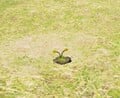 An Aristocrab Offspring buried underground in the Piklopedia.
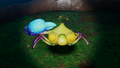 A closeup of an Aristocrab Offspring. Its eyes are currently not reflecting light.
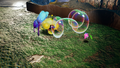 An Aristocrab Offspring blowing bubbles. Notice its eyes reflecting the light.
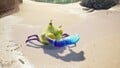 An Aristocrab Offspring in the Serene Shores swinging its claw across. Its eyes are bright yellow.
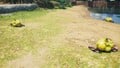 Three defeated Aristocrab Offspring in the Piklopedia.
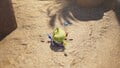 A closer look at the corpse of the Offspring.


