
Gildemandwee
| |||
|---|---|---|---|

| |||
| Appears in | Pikmin 4 | ||
| Scientific name | Salamandra falsaurum (juvenile) | ||
| Family | Amphibiland | ||
| Areas | Hero's Hideaway (Story Mode and Olimar's Shipwreck Tale) | ||
| Caves | Doppelgänger's Den, Dream Home | ||
| Night expeditions | None | ||
| Dandori Challenge stages | None | ||
| Dandori Battle stages | None | ||
| Attacks | Eat Pikmin, confuse Treasure Gauge | ||

The Gildemandwee (ザコサンショウ?, lit.: "Small-Fry Salamander") is an enemy in Pikmin 4. It is a brown, salamander-like creature with a glowing antenna resembling that of an anglerfish, and golden stones on its back. It is the juvenile form of the Gildemander, and can sometimes be found inside nectar eggs.
Stats[edit]
| Weight | Max. carriers |
Seeds | Value | Health |
|---|---|---|---|---|
| 5 | 10 | 6 |  × 5 × 5
|
500 |
The HP for the chunk on the creature's back is the same as the actual healthbar, being 500.
Behavior[edit]
When alone, Gildemandwees waddle around slowly. When noticing the player or Pikmin, they start waddling quickly towards their intended target; they attack by using their tongues to lick up and eat Pikmin. When Gildemandwees lose sight of their targets, they will stop abruptly, look side to side, and then resume slowly waddling.

If a player throws Pikmin onto the golden stones on their backs, they will shake them off, unless the stone is knocked off first. When the golden stone falls after being attacked, Gildemandwees get slightly dazed before rushing over to the stone, which they flip onto their backs with their tongue. If the golden stone is destroyed before it is replaced, Gildemandwees will continue to attack their targets, now with an exposed weak spot. When Gildemandwees are defeated, they stick out their tongue and flip on their back.

If a Gildemandwee is active in the area or sublevel, the Treasure Gauge will act as if there is treasure remaining, even if the area or sublevel is 100% cleared. This even goes as far as the game warning the player that they have not collected all treasures on the current sublevel, should a Gildemandwee still be alive after collecting all treasures when attempting to leave the current sublevel. Interestingly, if the Gildemanwee is dead but the golden stone isn't destroyed, this will not happen; this is probably a programming error.
Appearance[edit]
Gildemandwees have brown bodies, white bellies, black beady eyes, and stubby limbs. They somewhat resemble real-world salamanders. On their foreheads are dangling lanterns, similar to one of an anglerfish, with a pulsing yellow light. On their backs are gold-colored stones that they use to protect their weak spots underneath. If exposed, the weak spot is a red lump that shatters upon defeat. If the golden stone is destroyed whilst a Gildemandwee is still alive, the lantern turns off.
Gildemandwees are actually the juvenile forms of Gildemanders, although unlike their adult counterparts, they only have one golden chunk and can't effectively use their antennae to control Pikmin.
Locations[edit]
Strategy[edit]
|
The following article or section contains guides. |
Gildemandwees have only one weak spot on their backs, which is the only spot that is capable of taking damage. This spot is protected by a false gold nugget that has to be removed before attacking. This can be accomplished by throwing Pikmin at it, in which case Purple Pikmin are the best option due to their high impact damage and ability to latch on, but it is preferable to use Oatchi's rush attack, since its trajectory allows Pikmin to latch onto the weak spot once the nugget is removed. Care must be taken to manage your squad; if any Pikmin are attacking the nugget when the Gildemandwee retrieves it, they will perish.
Notes[edit]
Dalmo's notes[edit]
Olimar's notes[edit]
“Immediately after hatching, this species presents itself in a gilled, tadpole-like form and grows its legs after about a week.
This juvenile Gildemander specimen is estimated to be about one month old due to the presence of an ore-like growth on its back and the fact that it has already emerged onto land.
The living ore has substances similar to treasure within it, a peculiar scent, and has an effect on both sensors and Pikmin. However, the lantern organ on its head is still undeveloped and can only emit very faint electromagnetic waves. For this reason, juvenile Gildemanders often hide out of sight to avoid Pikmin attacks.”Louie's notes[edit]
Pikmin Garden[edit]
Text
“タカラサンショウの幼体。水辺に産みつけられた卵からふ化した直後はオタマジャクシの姿をしている。生後1週間で足が生え、1か月ほどで背中に鉱物ができると陸へ上がる。
特徴 その1 生体鉱物
- 小さいながらも、成体と同様に獲物をおびき寄せるにおいを発する。
- (Image text: 幼体時は腺の数が1つだが、成長するにつれ3つまで増える)
特徴 その2 電磁波
- 提灯状の器官は未成熟で、電磁波はほとんど放出していない。
- (Image text: ピクミンに襲われないように、物陰に隠れていることが多い)”
Translation
“A juvenile Gildemander. Immediately after hatching from eggs laid on the water's edge, they look like tadpoles. They grow legs at one week old, and emerge onto land when a mineral forms on their back at about one month old.
Feature #1: Biomineral
- Despite its small size, it emits a scent that lures prey, just like the adults.
- (Image text: "The juvenile has one gland, but as it grows, the number of glands increases to three")
Feature #2: Electromagnetic waves
- The lantern-shaped organ is underdeveloped and emits almost no electromagnetic waves.
- (Image text: "They often hide to avoid being attacked by Pikmin")”
Other information[edit]
- Pikmin 4 Piklopedia number: #62
Naming[edit]
- See more: Amphibiland family#Naming.
- Common name: Gildemandwee. "Gilde" may refer to the word "gilded", meaning golden, "mand" refers to the middle part of the word "salamander", and "wee" refers to the word little, itself a reference to the Gildemandwee's juvenile form.
- Japanese nickname: ザコサンショウ?, lit.: "Small-Fry Salamander". It combines "雑魚?" (small fry) and "山椒魚?" (salamander).
- Japanese name: ニセガネオカアンコウ 幼体?, lit.: "Counterfeit Money Hill Anglerfish (juvenile)". "Counterfeit money" refers to the fake gold on its back.
- Scientific name: Salamandra falsaurum (juvenile). Salamandra refers to the real life genus of salamanders. Falsaurummay be a combination of falsum and aurum, Latin for "fraud" and "gold" respectively. This refers to how the gold stone it carries disrupts the Treasure Gauge.
- Internal names:
NISEZAKO. "Nise" comes from "ニセガネ", which means counterfeit money. "Zako", or "ザコ", which means small fry, refers to how it is the juvenile form of Gildemander. - Prerelease: None.
Names in other languages[edit]
| Language | Name | Meaning | Notes |
|---|---|---|---|
 Japanese Japanese |
ザコサンショウ? Zako Sanshō |
Small-Fry Salamander | |
 Dutch Dutch |
Kleine guldamander | Small gildemander | |
 French French |
Aurimandrille | Little goldmander | "Aurimandre" (Gildemander) with the diminutive suffix "-ille" |
 German German |
Schatzamanderlein | Gildemanderling | "Schatzamander" (Gildemander) with the diminutive suffix "-lein" |
 Italian Italian |
Oromandrina | Little goldmander | "Oromandra" (Gildemander) with the diminutive suffix "-ina" |
 Korean Korean |
꼬마도롱뇽 Kkoma-Dorongnyong |
Little Salamander | |
 Portuguese Portuguese |
Ouromandrinha | Little goldmander | "Ouromandra" (Gildemander) with the diminutive suffix "-inha" |
 Spanish Spanish |
Aurimandrucha | Golden small-Fry Salamander | "Aurimandra" (Gildemander) with the pejorative suffix "-ucha" |
Gallery[edit]
|
This article or section is in need of more images. Particularly: |
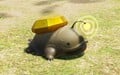 A Gildemandwee in the Piklopedia.
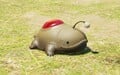 A Gildemandwee with its gold stone destroyed and its weak point exposed.
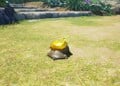 The backside of a Gildemandwee.
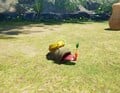 A Gildemandwee eating a Pikpik Carrot.
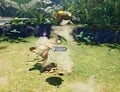 A Gildemandwee popping out of a breakable pot.
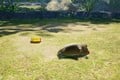 The corpse of a Gildemandwee. Its gold chunk lays in the background.
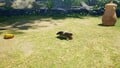 A Gildemandwee's corpse from a different angle.
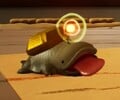 A Gildemandwee in the Hero's Hideaway.
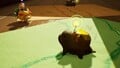 A Gildemandwee noticing the player.
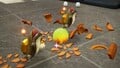 Two Gildemandwees popping out of some breakable pots next to the Searing Acidshock.
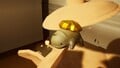 Screenshot of the Gildemandwee jumping out of a breakable pot. Note the Gildemandwee's small size.
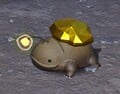 A Gildemandwee as seen in the Doppelgänger's Den.
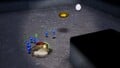 A Gildemandwee's gold being thrown off distracting Blue Pikmin.
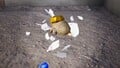 A Gildemandwee coming out of a nectar egg.


